Honoring Joanna Macy: A Spiral of Remembrance
Originally published on Jul 21, 2025 by https://gipl.org/blog/honoring-joanna-macy-a-spiral-of-remembrance

It is with deep sorrow and profound gratitude that I and the team at Georgia Interfaith Power & Light (GIPL) honor the passing of Dr. Joanna Rogers Macy, Ph.D., who completed her transition from this life on July 19, at the age of 96. A visionary teacher, world-renowned Buddhist scholar, author, environmental activist, and spiritual guide, her life was a beacon of courage and compassion to so many, including myself.
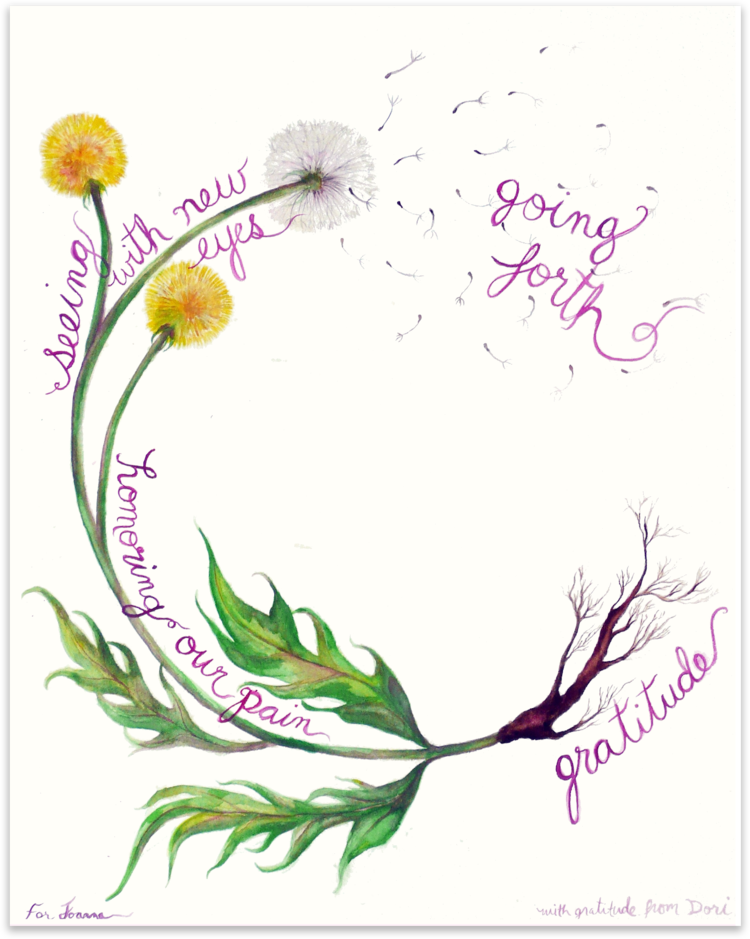
After years of being deeply influenced by the writings of Joanna Macy and the interactive group process she helped develop, known as The Work That Reconnects (WTR), it feels natural to begin this remembrance of her with the spiral used in this framework: The first of that spiral is “Gratitude.” I want to honor her and express my profound gratitude for the privilege to be “Planet People” together, a term that Joanna used to describe people who act on behalf of the life of our planet.
I have a well-loved, dog-earred, heavily underlined copy of Coming Back to Life (the comprehensive guidebook for the Work That Reconnects that she co-authored with Molly Brown) so when I met her in 2016 at a three-day workshop she was leading at the Rowe Center in Massachusetts, I knew that I would be in the presence of a wise teacher. Upon meeting her, I also experienced her incredible combination of intellect, compassion, and groundedness. In Coming Back to Life, she wrote, “ So, as a guide, assume a natural authority without altering your manner. Don’t get precious about it. Don’t assume a special tone of voice or pious measured speech; that just puts people off.” That is exactly who she was and how she led the workshop. She was so real, present, and open-hearted to both the beauty and suffering in the room and in our world.
The next part of the spiral is “Honoring Our Pain.” In 1979, Joanna published the article “How to Deal with Despair” in the June issue of New Age. Her initial workshops were called “From Despair to Empowerment,” as she courageously created a space where people could express their grief.
In her book, Pass it On, Joanna explained, “It is a dark time, filled with much suffering and almost total uncertainty. Like living cells in a larger body, it is natural that we feel the trauma of our world. So don’t be afraid of the anguish you feel, or the anger or fear. These responses arise from the depth of your caring and the truth of your interconnectedness with all beings.”
In Coming Back to Life, Macy and Brown continue, “Our pain for the world…is dysfunctional only to the point where it is misunderstood and repressed. By honoring our pain for the world we open a gateway into deep participation in the world’s self-healing.”
It was life-changing to reframe my pain for the world as natural and understand that it’s my response-ability to be part of a planetary feedback loop, rather than me just being “too sensitive.” We live in a society that views pain as dysfunctional, so we may be conditioned to repress our pain, but through exercises and grief rituals in WTR, I came to learn that it was my pain for the world that forged my path. The despair I felt when I saw brutal animal slaughters, the scarred earth from clear-cut forests, and the crushing burden of environmental injustice felt overwhelming, but it also pointed me to a community of people who share my heartbreak. It was a way to be part of the Earth’s immune system.
When I was in college, I was drawn to the writings of Deep Ecologist Arne Naess. Nearly twenty years later, I had almost a déjà vu sense when I discovered that Joanna was a scholar of Buddhism, Systems Thinking, and Deep Ecology, and co-authored Thinking Like a Mountain with Pat Fleming, John Seed, and Arne Naess. It felt like my younger self had left a clue for my future self along the way. This experience made the next part of the spiral particularly resonant.
The third section of the spiral, “Seeing With New/Ancient Eyes,” encourages us to use our moral imagination to communicate with ancestors, descendants, and the more-than-human world. Rituals, like the Council of All Beings, show us how intimately and inextricably connected we are to all that is.
I started facilitating WTR in my mid-40s, balancing motherhood and my environmental activism, hoping that it wasn’t too late for a meaningful career. Reading Joanna’s memoir, Widening Circles, I was inspired to learn that she finished her doctoral dissertation at 49 and began her life-defining despair and empowerment work at 50.
In 2019, I wrote to Joanna and Anne Symens-Bucher, her life-long friend, assistant, and one of the founders of Canticle Farm, to let them know that my book club was reading Widening Circles and asked if Joanna might have some advice to share with our group on the difficulty of balancing motherhood and still becoming self-actualized, and how those possibilities may start to open at this point in our lives. Her generous response gave me a different, multi-generational perspective:
“For much of my life, I did not think I was a great mother because I was involved in so many things that took me away from my children. I was in a hurry and often impatient. But the older I get, many of my maternal self-judgments have fallen away, especially as I am hanging out with my adult children. All 3 of them have chosen to move to Berkeley and live within walking distance. And in my 3 grandchildren, I see the values I so cherish being lived and embodied. Remember to be compassionate with yourselves as you live into the balance of mothering your children and serving your world.”
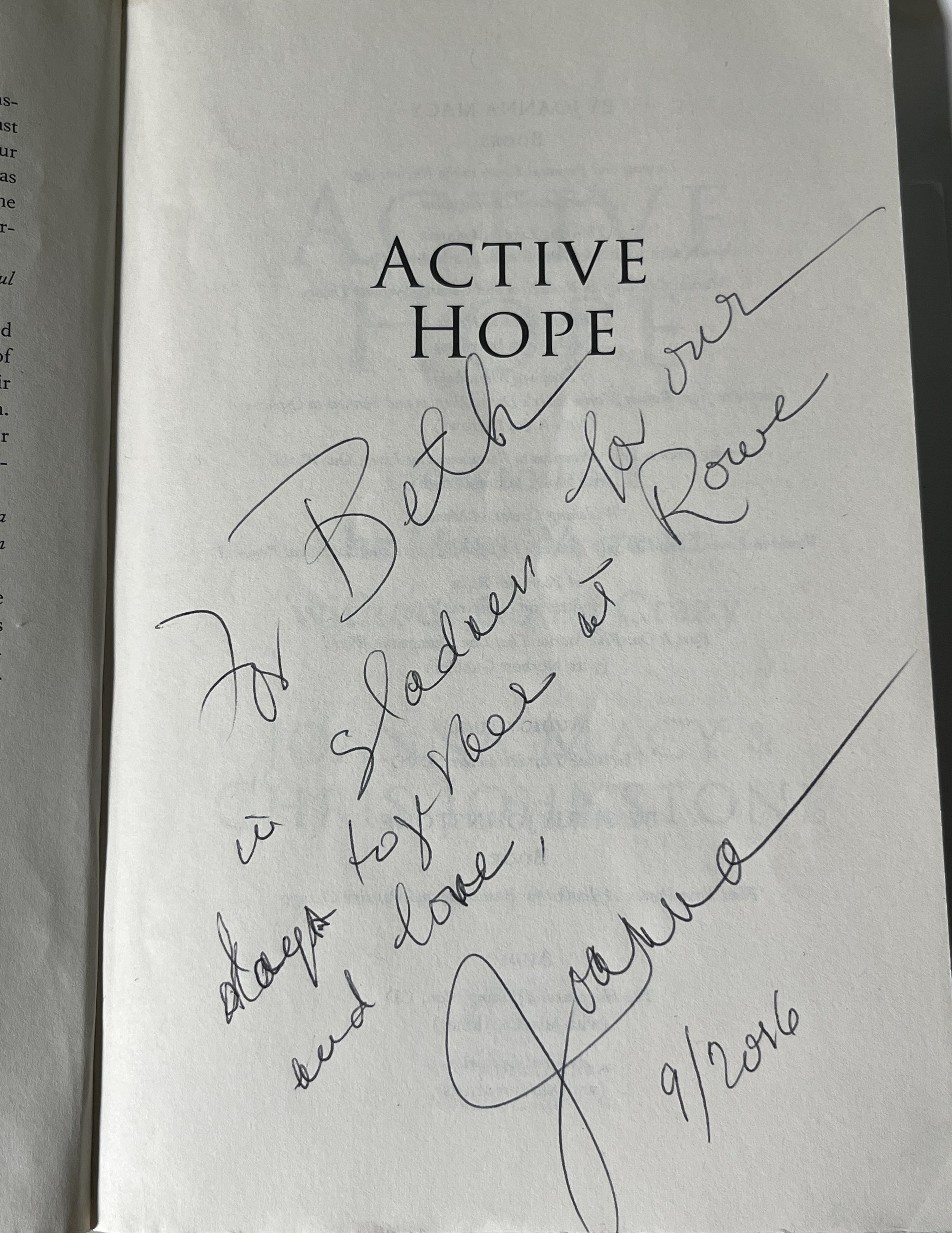
Toward the end of the workshop with Joanna in 2016, there was an opportunity to share our intentions for Going Forth, the last part of the spiral. There was no time to hear from everyone, but I was one of the lucky few who were selected to share how they planned to “commit themselves”to the work. I declared that I wanted to teach The Work That Reconnects in faith communities. At that time, I was on the Education Committee at Georgia Interfaith Power and Light (GIPL) and the Unity Worldwide Ministries EarthCare Team, so it felt like I might already have accessible and powerful audiences for facilitation.
On the final morning of the workshop, I had a soulful moment with Joanna in the house where I was fortunate enough to stay with her that weekend. With tears of reverence in my eyes, I thanked her for all that she taught me and asked for her blessing to teach this work. She kindly gave it to me and I felt like my path in life was more clear than it had been in a long time.
Over the last nine years, I have facilitated more than 80 workshops, most of which are through GIPL’s Active Hope.
Spiraling back into Gratitude, a common refrain in this work is to “not try to do it alone.”
Not only is it more enjoyable and sustainable to be in community with each other, it also leaves the possibility for what is known in systems theory as “emergent properties.” When we combine our lifeforce with others, there is the potential to create something that is more significant than what we could have built on our own as individuals, and Joanna Macy often said that it is the potential of emergent properties that gives her hope.
I experienced emergence meeting Carol Bartlett for the first time, who co-founded GIPL with her husband, Rev. Woody Bartlett, in 2003. Early in our conversations, we realized that we both admired Joanna Macy’s work, and her name became a password that unlocked a deep friendship as well as a whole other layer of communication.
Later that year, after the workshop, another one of my soul sisters, Elizabeth Devereux, introduced me to her dear friend, Sara Lindkrantz, who wanted to offer some financial support to help bring WTR to more people. Carol, Elizabeth, Sara and I met, and after a heartfelt and enlivening conversation, the four of us sitting at a table overlooking the lake and mountains, we talked about what we should call this fund. Sara looked at us and said, “What do you think about the Four Directions?” It was perfect!
Years later, The Four Directions Fund offered through GIPL continues to help faith communities “go forth” by giving them the opportunity to apply for a seed grant of up to $500 to fund an eco-project of their choice.
In Active Hope, Macy and Johnstone wrote:
Active Hope is waking up to the beauty of life
on whose behalf we can act.
We belong to this world.
The web of life is calling us forth at this time.
We’ve come a long way and are here to play our part.
With Active Hope, we realize that there are adventures in store,
strengths to discover, and comrades to link arms with.
Dear Joanna, thank you for playing your part so magnificently, for reminding us that it is a privilege to take part in this glorious adventure we call life, and for creating a transformative body of work that has allowed me to link arms with you and so many amazing people who share your “wild love for the world.” I continue to “vow to myself and to each of you: To commit myself daily to the healing of our world and the welfare of all beings.”
If you want to learn more about Joanna Macy, and discover her work, here are a few places to start:
- Joanna Macy – Information about Joanna and her publications.
- Active Hope – A free, video-based, engaging & practical online course designed to nourish our capacity to make a difference in the world.
- Work That Reconnects Network – A global network of people dedicated to offering resources and a wide variety of community events.
- School for The Great Turning -Offers online and in-person education inspired by the Work That Reconnects.
- Podcasts: On Being – A Wild Love for the World, Macy and Barrows on Rilke Translations, and Hope Portal #5
- Emergence Magazine – Widening Circles: An Interview with Joanna Macy
- We are the Great Turning Podcast Series: Love, Courage, and Connection in the Climate Crisis
- The Great Simplification with John Seed and Skye Cielita Flo about practices in The Work That Reconnects

On Being Similar
By Anastasia Lawson, Andrew Meador, Beth Remmes, and Daniel Simons
Group Project for Biomimicry Ethos, ASU Biomimicry Master’s Program

The essential elements of biomimicry Ethos, (Re)Connect, and Emulate are often the pathways into practice. These elements do not follow a linear progression, rather they mutually reinforce and strengthen biomimicry as a whole.
The element most immediately associated with biomimicry is Emulate, which seeks to replicate nature’s genius. While the end goal of the emulation element of biomimicry is to create innovative products or social transformation, a large amount of time and energy is spent in an information-gathering phase where we explore questions like, “What would nature do here? What wouldn’t nature do here? How does nature…?” Hours of research uncovers organisms with diverse survival strategies, including functions and adaptations that contribute to their success and reveal time-tested strategies present across taxa.
For example, there is much we can learn from trees. They clean air, create homes for smaller creatures, and can outlive most other organisms. These features exemplify every organism’s use of biological traits and strategies to realize its inherent potential as a living entity. Furthermore, the study of these features enhances our understanding of what is currently known about nature’s genius and reminds us that genius is not reserved for humans alone. In fact, many of our most successful designs occur when we quiet our cleverness, engage our curiosity, and focus on knowing an organism especially well.
A true emulation design spiral requires deep knowledge of an organism’s strategies. These strategies cannot be fully understood without recognizing the abiotic and biotic context in which the organism thrives. Imagine trying to develop a branch-like, wind-resistant design while ignoring root structures and local weather conditions— focusing solely on a feature without its context restricts the effectiveness of the design and results in weak biomimicry. And even the most rigorous research can fall short of fully comprehending nature’s genius if we fail to acknowledge that many features are multi-functional and many organisms have mutualistic, intertwined relationships with others. This teaches us to appreciate the intrinsic value of the living entity regardless of their instrumental use to humans. From this lesson, we also learn to respect the underlying powers of the universe that nurture this life into existence.
The second essential element, (Re)Connect, is the strengthening of our connection to and positive engagement with nature. Trees cannot live on sunlight and water (abiotic factors) alone; they also rely on other organisms to facilitate nutrient distribution and pollination. Similarly, humans rely on trees for shelter, warmth, food and critical environmental services. These interdependencies quickly reveal a complex web of natural relationships and connectedness that creates the foundation for human life. This reminds us of our own biological nature, connectedness to other living entities, and the system upon which all life depends. Like Indra’s Jeweled Net, seeing the beauty of life in one organism reflects the beauty of the world and inspires the inevitable realization that all life is connected in this cosmic matrix.
The third essential element of biomimicry is Ethos—our motivations, intentions, and the spirit with which we approach learning from nature’s genius. An incredible amount of harm is wrought by the built environment and our unnatural approaches to many facets of manufacturing and design. This element ensures that the emulation phase does not just end at the mechanics, but rather it is a holistic approach that includes life’s ability to operate at ambient temperatures and pressures and does not create toxic byproducts. Authentic biomimicry presents an opportunity to learn from nature as a mentor, model, and measure, to assess how well we are “fitting in” with the rest of Life.
As Taylor discusses in The Ethics of Respect for Nature, in the human-centered view of life, the value of animals and plants is considered exclusively in terms of their satisfaction of human needs or interests. There is no evaluation or questioning of whether humans were promoting the well- being of other creatures when they felled old growth trees for lumber or burned forests for farmland. Through biomimicry’s Ethos, we are challenged to reflect and act upon the harmful ripples of our present designs. We learn that we must evaluate our actions, and their consequences, against the aim of promoting the well- being of all creatures.
With so many complex, modern challenges, humanity must work for the good of the biosphere to ensure the survival of all species [where “good” is marked by the ability to maintain itself through generations, and the average good is at an optimum level for the given environment (Taylor, 1986)]. Just as the acorn is encoded with the potential to become an oak, we too have the potential to follow a life-enhancing trajectory. The practice of biomimicry, arising from the three essential elements of Emulation, (Re)Connect, and Ethos, holds the tools and promise of helping us rediscover our role in the community of life and to create a lasting, positive impact as a keystone species for the good of all living organisms.
References
Taylor, P. (1986). The Ethics of Respect for Nature. Available from: https://rintintin.colorado.edu/~vancecd/phil308/Taylor.pdf
I had the privilege of representing Georgia Interfaith Power and Light at the Unitarian Universalist Congregation of Atlanta for their Earth Day service today. Rev. Taryn Strauss gave an inspiring sermon about care for creation. She referenced Ayana Elizabeth Johnson’s All We Can Save Project, and her Venn diagram to help people find their place in climate action.
`
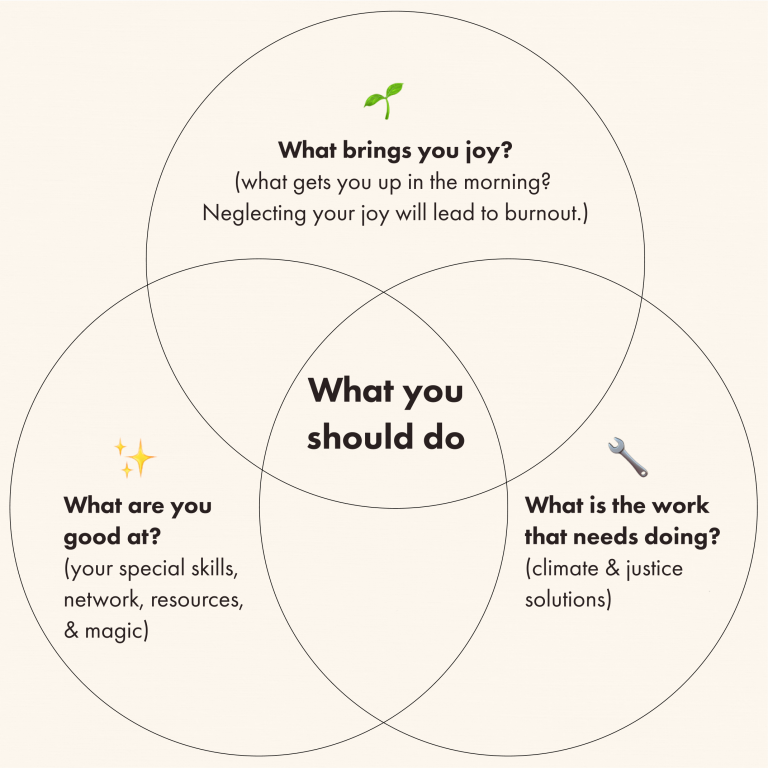
Unfortunately, the answers to these questions aren’t always obvious, which is why I love facilitating the Work That Reconnects. It helps us to recognize our unique gifts and move through despair and into joy. It also connects us with possibilities in the Great Turning and a supportive community of changemakers.
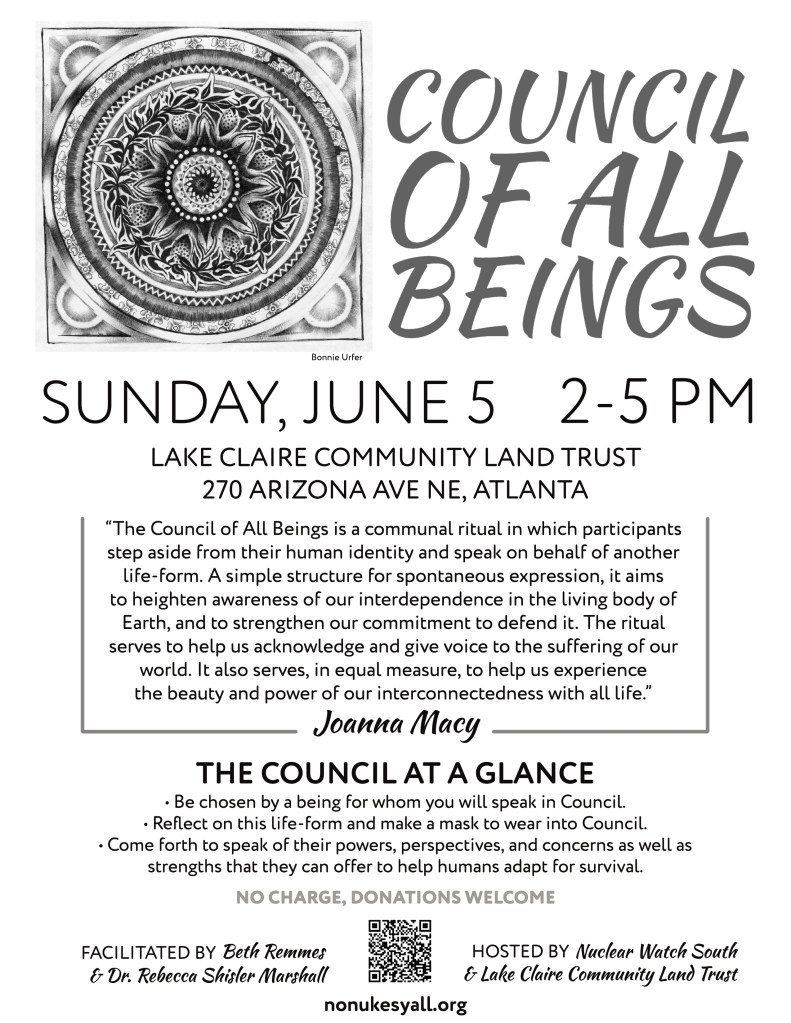
Nuclear Watch South and Green Friends at Atlanta Friends Meeting, have joined together to sponsor a full-day workshop on Saturday, June 4th. We are also holding a Council of All Beings at the Lake Clair Community Land Trust on Sunday, June 5th. Both events are free and open to the public, although it would help us if you could register here so we have an idea of how many people to expect.
I hope to see you at one or both of these events!
Much love,
Beth

 Earth Spirit Action